From Developer to Product Builder: 5 Levels, With AI
The ticket said: add a CSV export button to the reports page. I built it in an afternoon. Clean code, tests green, shipped before Friday. My lead said nice work.
Nobody used it.
I found out three weeks later, digging through analytics for something else. Zero clicks. Not “low usage” — zero. The customers who asked for “export” didn’t want a button on a page they never opened. They wanted the numbers to show up in their inbox every Monday morning. A different thing entirely. The ticket was wrong, and I had shipped it perfectly.
That was the day I understood the job I was actually good at — closing tickets cleanly — was not the job that mattered. And it took me an embarrassingly long time, plus a wave of AI tools, to climb out of it.
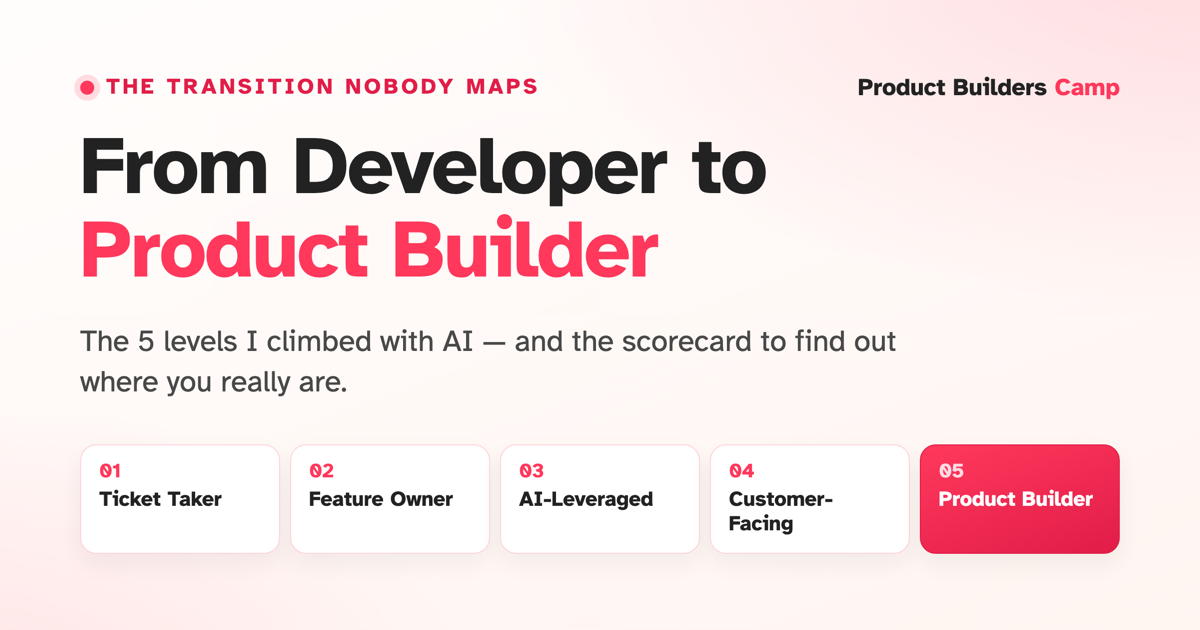
This is the map I wish I’d had. Five levels from developer to product builder, and a scorecard to find out where you really are.
Developer vs. product builder
A developer asks: what should I build?
A product builder asks: should this be built at all — and is this the version a customer would pay for?
That’s the whole shift in one line. A developer takes the requirement as given and optimizes the how. A product builder treats the requirement as a hypothesis and owns the what and the why. One measures themselves by output shipped. The other measures themselves by the customer outcome — and will happily throw away a week of clean code if the outcome says the code was pointed at the wrong problem.
For most of my career, nobody wanted the second person. They wanted tickets closed. So I got very good at closing tickets.
Then AI showed up and quietly deleted the part of the job I’d been hiding behind.
What AI actually changed
Here’s the uncomfortable thing about the CSV button: writing it was the easy part. The hard part — the part I skipped — was noticing it was the wrong thing to build. But writing code was scarce and slow, so writing it well felt like the whole job. The scarcity hid the truth.
AI collapsed that scarcity. When you can scaffold a feature in an hour instead of a week, “I can build it” stops being impressive. Everyone can build it. The code is no longer the moat.
What’s left is everything the code was never about:
- Knowing which thing to build, out of the hundred you now could.
- Feeling the product like a customer, so you catch the version that’s technically correct but miserable to use.
- Shipping it end to end without being chased.
- Turning what you learned into something your teammates can reuse.
AI didn’t replace the developer. It commoditized the developer’s old job and promoted the parts that were always the real work. The people who saw that early started moving at a speed that looked like cheating. The people who didn’t kept polishing CSV buttons.
That gap doesn’t close in one leap. It closes in levels. Here are the five I climbed.
The 5 levels
Level 1 — The Ticket Taker
You execute specs. Someone else decides what’s worth building; you turn it into working code. You’re measured by throughput, and you’re proud of clean, correct output. This is a real skill and a fine place to start — but the ceiling is low, because your value is capped at how well you translate someone else’s judgment. This was me and the CSV button. Correct, closed, useless.
You level up when you stop trusting the ticket and start asking who it’s for.
Level 2 — The Feature Owner
You own a feature end to end — not just the code, but the edge cases, the empty states, the “what happens when this fails” that the ticket never mentioned. You still wait to be told what to build, but you own how well it gets built. You’ve stopped shipping the happy path and calling it done. The failure modes are handled here, not left for the next person to clean up.
You level up when handling the work stops being enough and you start questioning the work itself.
Level 3 — The AI-Leveraged Builder
This is where AI changes your slope, not just your speed. You ship in a day what used to take a week — but the real unlock isn’t typing faster. It’s that you build leverage that compounds: the skill, the doc, the test, the internal tool that makes the next task faster for you and everyone after you. A Level 1 with AI closes tickets a bit quicker. A Level 3 with AI bends the curve — every task leaves the next one cheaper. If your throughput on similar work hasn’t visibly jumped, you’re using AI as autocomplete, not as leverage.
You level up when speed stops being the point and you turn that reclaimed time toward the customer.
Level 4 — The Customer-Facing Owner
Now you feel the product like the person paying for it. You open the thing you built and ask “would I actually pay for this experience?” — and you catch the slow load, the confusing layout, the broken empty state before the customer does. You push back on tickets that are wrong for the customer, with a customer reason, not a technical preference. You’d have caught the CSV button here — not because the code was bad, but because you’d have used it once and thought nobody wants this.
You level up when catching the wrong thing isn’t enough and you start deciding the right thing.
Level 5 — The Product Builder
You decide what gets built and why it’s worth someone’s money. You ship it without being chased, on top of the rocks and emergencies of a normal week. And you don’t hoard what you learn — you leave the system smarter than you found it, so the next person moves faster. Closing the ticket was never the goal. The customer outcome is. At this level you own that outcome, end to end, and you’d rather build the smaller right thing than the bigger wrong one.
Levels tell you where you are. They don’t tell you what you’re graded on once you’re playing this game. That’s the scorecard.
The product builder scorecard
Five dimensions. This is the rubric I now use on myself — and it’s brutally clarifying, because you can be Level 5 on one line and Level 2 on another.
| # | Dimension | A developer… | A product builder… |
|---|---|---|---|
| 1 | Product judgment | builds the ticket as written | changes what gets built when the ticket is wrong — for a customer reason — and is right |
| 2 | Customer-experience ownership | ships when the code is correct | ships when the experience is good; catches slow, confusing, or broken before the customer does |
| 3 | AI leverage | uses AI to type faster | ships in a day what took a week, and builds skills, docs, and tests that make the next task faster |
| 4 | Independence & follow-through | delivers what they’re assigned, when chased | finishes the work due today, today — on top of rocks and emergencies, without being followed up |
| 5 | Knowledge sharing | keeps what they know in their head | documents the thing only they know, pairs to teach and learn, and steps into unfamiliar areas |
The trap is thinking these are soft skills. They’re not. Each one is a concrete, observable behavior with evidence attached: a scope you changed for a product reason and were right about; a bad experience you refused to ship even though it technically worked; a visible jump in your throughput; a task done the day it was due; a doc or skill a teammate now uses. Vibes don’t count. Evidence does.
Score yourself
Rate yourself 0–5 on each dimension. Be honest — grade on evidence from the last month, not on intentions.
- 0–8 — You’re a strong Level 1–2. The code is the job right now. That’s fine; it’s the foundation everything else stands on.
- 9–16 — You’re mid-climb. Usually strong on the craft dimensions (2, 3) and thin on the ownership ones (1, 4). The fastest gains are in product judgment.
- 17–21 — You’re operating as a product builder on most days. The work now is consistency across all five, especially the one you keep scoring lowest on.
- 22–25 — You’re the person a team reorganizes itself around. The risk here isn’t skill; it’s silos. Dimension 5 is how you scale past yourself.
I sat around a 6 the day of the CSV button. Dead honest. Great at dimension 3-in-waiting, a zero at dimension 1.
The part nobody tells you
The climb isn’t linear and it isn’t permanent. Drop onto an unfamiliar codebase under pressure and you’ll feel yourself slide back to Level 1 — taking the ticket as given because you don’t have the context to question it yet. That’s normal. The levels aren’t a badge you earn once; they’re a gear you shift into.
And the multiplayer part matters more than the solo part. A Level 5 builder stuck behind a Level 2 reviewer who only checks whether the code compiles is still shipping at Level 2. You don’t climb this ladder alone — you pull your team up it, which is exactly why dimension 5 exists.
So: what level are you on, honestly? And what’s the one dimension you’d move first?
That question — and the climb that follows it — is the entire reason we built Product Builders Camp. Not to teach you to close tickets faster. To move you from the person who builds what they’re handed to the person who decides what’s worth building at all. The five levels of the curriculum are that climb, laid out as a program.
If you want the concrete version of what changes when you stop working at Level 1, I wrote about one of the sharpest examples in From the Debugger to the Feedback Loop — the night I realized I’d spent years doing a machine’s job by hand.
The CSV button taught me the difference the expensive way. You don’t have to.